The leap from solo operator to ten-person team is the hardest growth jump in service business ownership. The mechanics that worked when you were the only person executing the work (everything in your head, everything in your phone, everything on your schedule) break the day you bring on the third employee. By the time you reach ten people, you are either running a real business or running a circus.
This guide walks through the hiring decisions that matter, the tools that scale with team size, and how to manage a multilingual team without dropping the quality your name is built on.
Form-based, up to 10 minutes at the desk
- Type every line item on a phone
- Re-do the work back at the office
- Send hours or days later
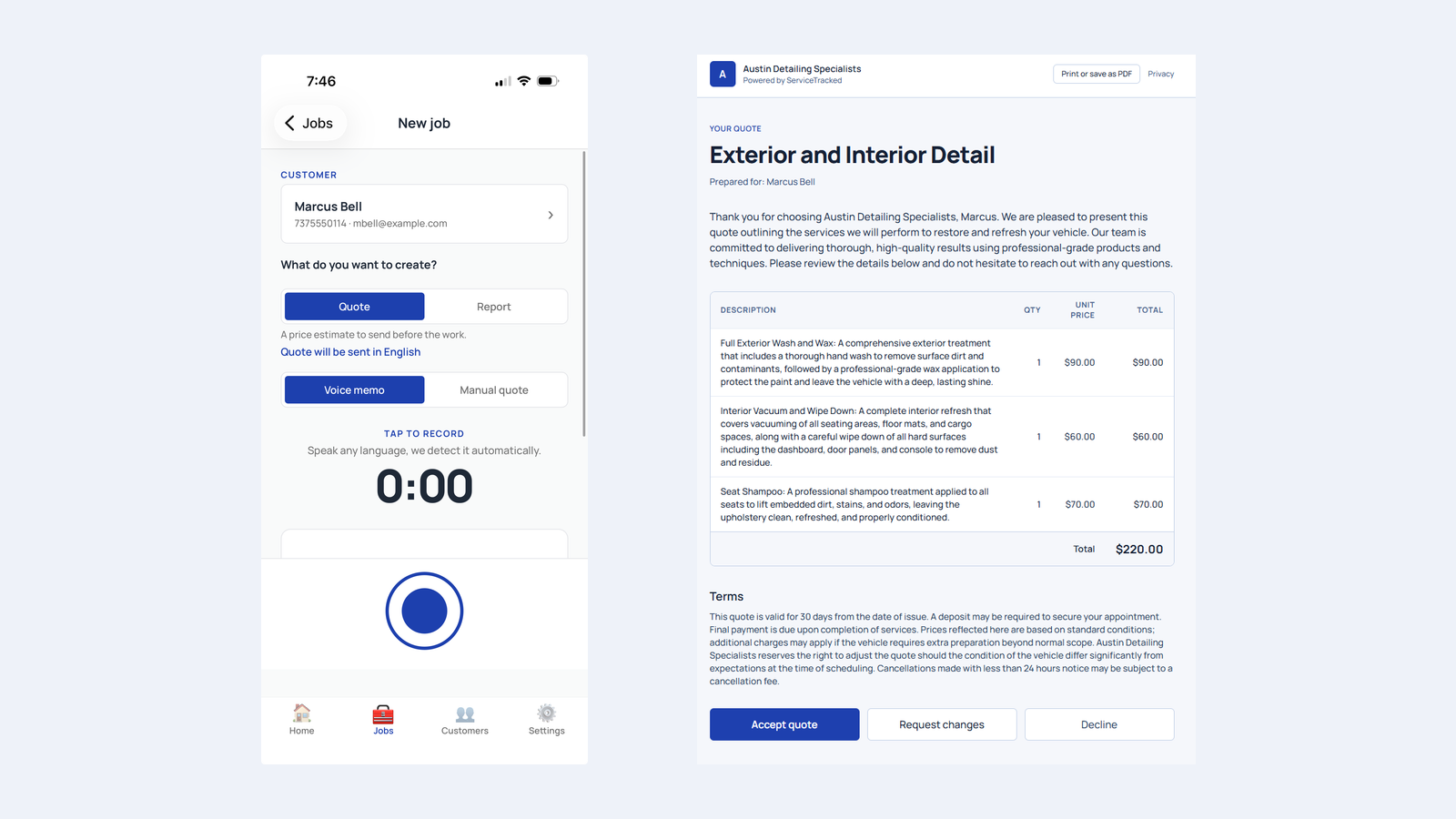
ServiceTracked, seconds on the job
- Speak the job once
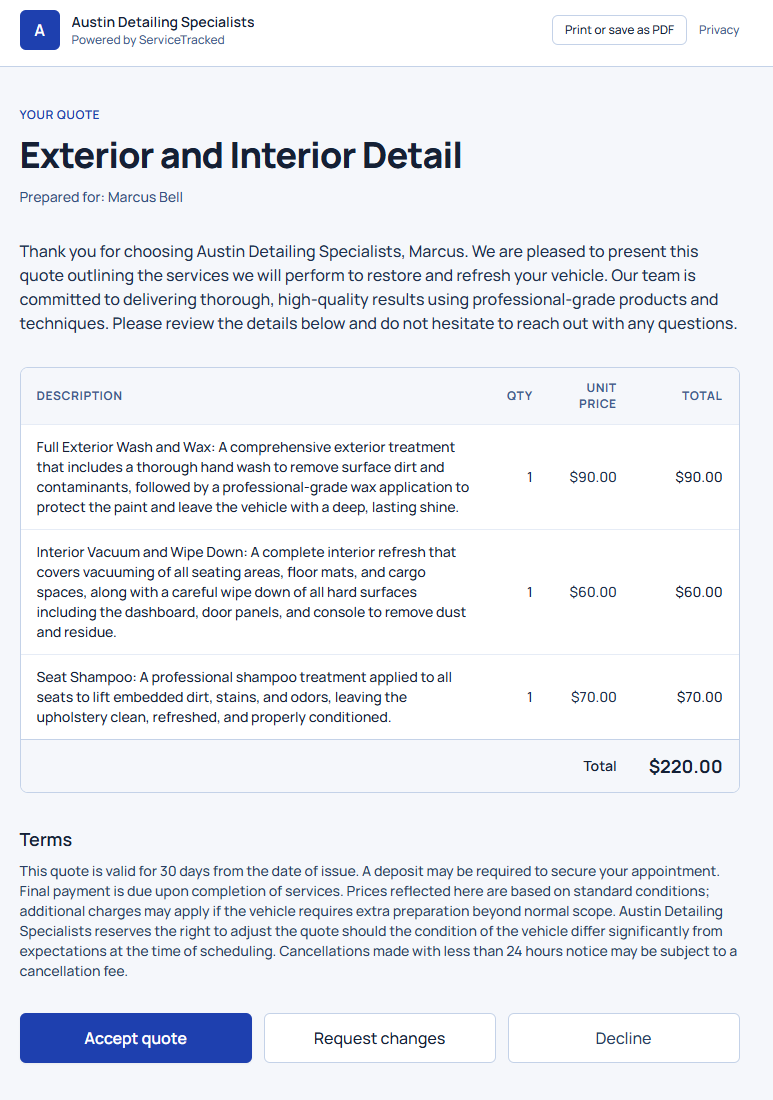
- Quote or Report builds itself
- Customer has it before you leave
The four stages of growth
Most service businesses move through four stages on the way to ten people. Each stage has a different bottleneck. If you treat all four the same way, you stall.
Stage 1: Solo (you only)
The bottleneck is your time. You are the salesperson, the technician, the bookkeeper, the dispatcher, and the marketing department. Revenue scales linearly with the number of hours you work. The right move at this stage is to eliminate the time sinks that do not produce revenue: bookkeeping, manual quoting, customer back-and-forth, paperwork. Every hour you reclaim is an hour you can spend on work that earns.
Stage 2: Solo plus one helper (two people)
The bottleneck is communication. You are still the customer-facing person, but now you have a helper who needs to know what you know. Most solo-plus-one businesses fail at this stage because the owner cannot stand the cost of taking the time to brief the helper on every job. The fix is documentation: every job has a written scope before the helper shows up. Voice-to-quote tools help here because the quote you sent to the customer is the same document that briefs the helper.
Stage 3: Small team (three to five people)
The bottleneck is consistency. You can no longer review every job before it goes out. The work other people do becomes "the work your business does." The right move is to standardize the deliverables: every quote looks the same, every report looks the same, every customer interaction follows the same script. This is the stage where most service businesses lose retention because the new employees produce visibly different work than the owner did.
Stage 4: Operations team (six to ten people)
The bottleneck is management. You now spend most of your time managing people instead of doing the work. The role of the owner shifts from "doer" to "designer of how the work gets done." Tools that report on team activity, flag quality issues, and surface customer feedback become more important than tools that help individual technicians.
Hiring decisions that matter
The mistakes that hurt most happen in hiring. Three rules separate businesses that scale cleanly from ones that thrash:
Hire for character before skill
Skill is teachable. Character is not. A new technician with limited experience but high reliability, communication, and customer-first instincts will outperform a more experienced technician who shows up late and argues with customers. This is especially true in trades where the work happens in the customer's home or on their property: the customer evaluates the technician on every visit, and one bad visit can lose a multi-year relationship.
Hire your second person before you are drowning
Most solo operators wait too long to hire. They hire when the workload is already crushing them, which means they hire the first person they interview because they are desperate. The result is a bad hire and three months of unwinding. The right time to hire is when you have six to eight weeks of overflow scheduled and you can afford the new person without dipping into reserves.
Hire roles, not people
When you hire a third or fourth person, define the role before the hire. "Lead technician for residential jobs" is a role. "Someone to help out" is not. The clearer the role definition, the better the hire and the easier the management.
Try it on your next job
Deliver a polished quote in under 60 seconds. Free Forever covers 10 quotes per month, no card.
Start free, no card requiredThe tools that scale with team size
The tools that work at each stage are different. A solo operator can run on a smartphone and a spreadsheet. A ten-person operation cannot. The hard part is replacing tools at the right time without losing the data you have built up.
Stage 1 to Stage 2: communication tools
When you bring on your first helper, you need shared visibility into the schedule. A shared calendar (Google Calendar or similar), a shared phone number that both of you answer, and a shared document repository (Google Drive, Dropbox, or similar) cover the basics. The pitfall is using texts or DMs for customer communication; the moment two people answer texts on the same number, customers fall through the cracks.
Stage 2 to Stage 3: standardized customer documents
When you grow to three or four people, the quality of the documents customers receive is the main signal of consistency. Every quote should have the same shape. Every report should have the same shape. Every email should have the same tone. ServiceTracked is built for this stage: every team member produces a quote or report that looks identical to one the owner would produce, because the format is enforced by the tool.
Stage 3 to Stage 4: operational reporting
At five-plus people, you need to see what your team is doing without being on every job. Customer-facing reports double as your operational reports: you can see which technician sent which quote, which jobs are pending acceptance, and which customers have not been followed up. This is where most service businesses transition from "everything in the owner's head" to "everything in a real system."
Stage 4 and beyond: management tools
At six to ten people, you need scheduling and dispatch software, payroll integration, and team-management features (employee status, role hierarchy, automatic seat management when employees come and go). These are usually layered on top of the customer-facing tools rather than replacing them.
Managing a multilingual team
Most service businesses that scale past five people end up with a multilingual team. In the US, this often looks like an English-speaking owner with Spanish-speaking technicians, or a Spanish-speaking owner with mixed-language staff. In Texas, Florida, Arizona, California, and the southwest, Spanish-speaking technicians are the majority of the workforce in trades like detailing, lawn care, cleaning, and construction.
The wrong way to manage a multilingual team is to require everyone to communicate in one language. You will lose your best technicians, and the customers will get worse service because the technicians cannot do their best work in their second language.
The right way is to let each technician work in their best language while every customer receives communication in their preferred language. A Spanish-speaking technician records a quote in Spanish; the customer receives it in English. A Vietnamese-speaking cleaner files a report in Vietnamese; the property manager receives it in English. The technician does their best work; the customer gets the polished output.
This is exactly the pattern ServiceTracked is built around. The technician chooses the speak language. The customer's preferred language determines what they receive. The tool bridges the gap automatically.
The effect on scaling is substantial. A business that removes the language tax from its workforce can hire the best technicians available in the market, not just the ones who happen to be bilingual. Hiring pool expands. Quality of work goes up. Customer experience improves because the technicians are not stretched thin trying to communicate in a second language.
Try it on your next job
Deliver a polished quote in under 60 seconds. Free Forever covers 10 quotes per month, no card.
Start free, no card requiredWhat changes at each headcount
A few specific things break at predictable headcount thresholds:
- At 3 people: you stop knowing what every customer needs. You need a customer database.
- At 5 people: you stop reviewing every quote and report. You need standardized templates.
- At 7 people: you stop scheduling everything yourself. You need a dispatch or scheduling system.
- At 10 people: you stop being a technician. You need a real operations role.
Plan for each transition before you hit it. The businesses that thrive at ten people are the ones that put the next-stage tools in place at the previous stage.
Free Forever
$0
10 per month, no card
Starter
$29
1 user, 60 per month
Solo
$49
1 user, unlimited
Team
$129
3 users, +$35 each
Business
$299
10 users, +$25 each
The financial reality
Adding a technician is not free. The standard rule of thumb: a new technician costs 1.5x their wage when you include taxes, insurance, equipment, and management overhead. A technician you pay $25 per hour costs you $37.50 fully loaded.
This means the new technician must produce $37.50 per hour of margin (not revenue) to be neutral, and significantly more to be profitable. The math gets tighter at higher headcounts because management overhead is real even if not always visible.
The tools that scale revenue per technician are the ones that pay back fastest. Voice-to-quote tools cut the time a technician spends per quote sharply. If your technicians are spending 30 minutes per quote and could spend 5 minutes, the math on adding a tool that costs $50 per technician per month is straightforward.
Try it on your next job
Deliver a polished quote in under 60 seconds. Free Forever covers 10 quotes per month, no card.
Start free, no card requiredThe owner role at ten people
The hardest transition is the owner's role at ten people. Most service business owners want to keep doing the work because the work is what they love. But at ten people, the owner who is still doing the work is the bottleneck. Customers wait on the owner because no one else can quote, dispatch, or close a job.
The owner role at ten people is designing how the work gets done, coaching the team, owning the most important customer relationships, and choosing the next hires. It is a different job than running a five-person team, and it takes most owners a while to settle into.
The owners who handle this transition well usually share a pattern: they accept early that they will personally do less work, and they invest in tools and systems that let other people do the work to their standard.
The bottom line
Scaling a solo service business to ten people is not a single decision. It is a series of small decisions made at the right time: hiring before you are drowning, standardizing documents before quality drifts, removing the language tax from your workforce, and transitioning the owner role at the right headcount.
ServiceTracked is built for service businesses at every stage of this growth. Free Forever covers a solo operator with 10 quotes and reports combined per month. The Starter tier is the paid entry point: $29 per month for 60 quotes and reports (combined) with full features including SMS to US customers. The Team tier covers small teams: 3 users included, then $35 per additional user, uncapped. The Business tier covers larger teams: 10 users included, then $25 per additional user, scaling with your team. Whatever stage you are at, the tools should scale with you, not get in your way.
Try it on your next job
Deliver a polished quote in under 60 seconds. Free Forever covers 10 quotes per month, no card.