Many solo service business owners lose hours every week to paperwork they do not even notice. The lost time is not in one big block; it is in twenty-minute fragments spread across the day. Twenty minutes typing a quote at lunch. Fifteen minutes writing a report at the end of a job. Ten minutes following up with a customer who has not responded. Half an hour at the end of the month reconciling who paid what.
Consider a rough example. If a quote takes fifteen minutes and you send eight in a day, that is two hours. If a report takes twenty minutes and you do six visits, that is another two hours. Add follow-ups, billing, and admin, and it is easy to spend the equivalent of two full workdays per week on paperwork that produces no revenue.
This guide audits where the time actually goes, then shows how a voice workflow compresses each step to a fraction of its current cost. The numbers below are illustrative estimates, not measured data; your own audit is what tells you the real figures for your business.
Form-based, up to 10 minutes at the desk
- Type every line item on a phone
- Re-do the work back at the office
- Send hours or days later
ServiceTracked, seconds on the job
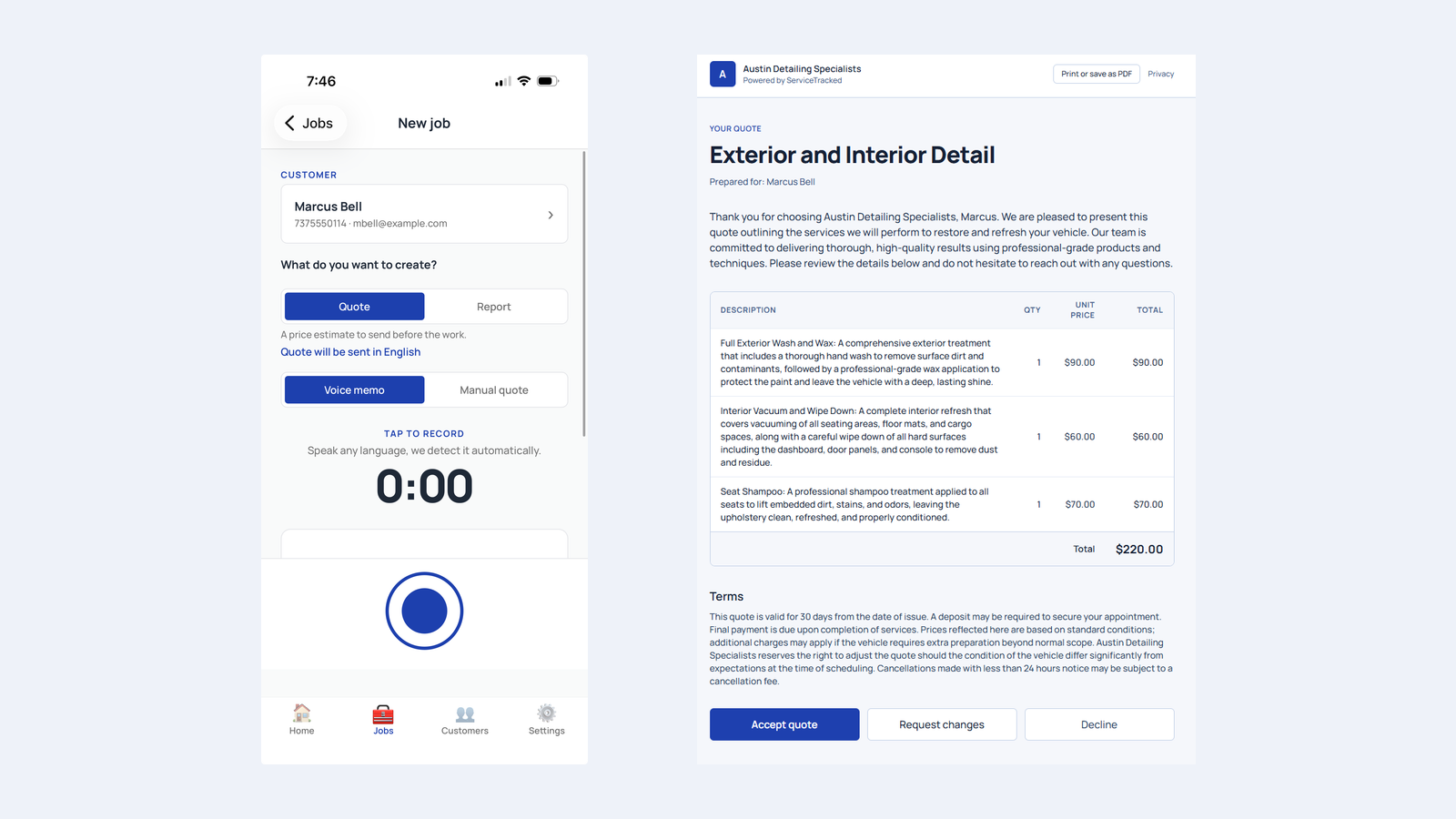
- Speak the job once
- Quote or Report builds itself
- Customer has it before you leave
The honest audit
Before you can reclaim time, you have to see where it goes. Track one normal week of work and log every paperwork activity in fifteen-minute increments. Many service business owners are surprised at the result.
An illustrative breakdown for a busy solo service business might look like this:
- Quotes: typing estimates, formatting, sending, follow-ups
- Reports: writing service reports, attaching photos, sending
- Customer back-and-forth: texts, emails, scheduling, clarifications
- Billing: invoicing, payment chasing, reconciliation
- Admin: paperwork for the business itself, taxes, insurance, licensing
Added up, this can easily reach a large fraction of the workweek that does not produce a paid hour.
You cannot eliminate all of it. Some of it is necessary. But the largest two categories (quotes and reports) are where a voice workflow makes the biggest difference, and the remaining categories can be trimmed as well.
You
Walking back to the van
“Black F-150, full interior shampoo and paint correction on the hood. Four eighty-five, can do it Saturday.”
Where the time actually goes in quoting
The time most solo businesses spend on quotes tends to break down like this:
- Reading the customer's request and deciding what to charge: 5 minutes per quote
- Typing the estimate in a notes app or email: 10 to 15 minutes per quote
- Formatting it so it looks professional: 3 to 5 minutes per quote
- Sending it: 1 minute
- Following up two days later: 3 to 5 minutes per quote
- Re-sending after edits or clarifications: up to 10 minutes per affected quote
Eight quotes per day at 15 to 30 minutes each is two to four hours daily. Most of that time is not deciding what to charge; it is the mechanics of producing the document.
The voice workflow cuts this dramatically:
- Reading the customer's request: 1 minute
- Recording a voice memo with name, scope, line items, total: 30 to 45 seconds
- Tapping send: 1 second
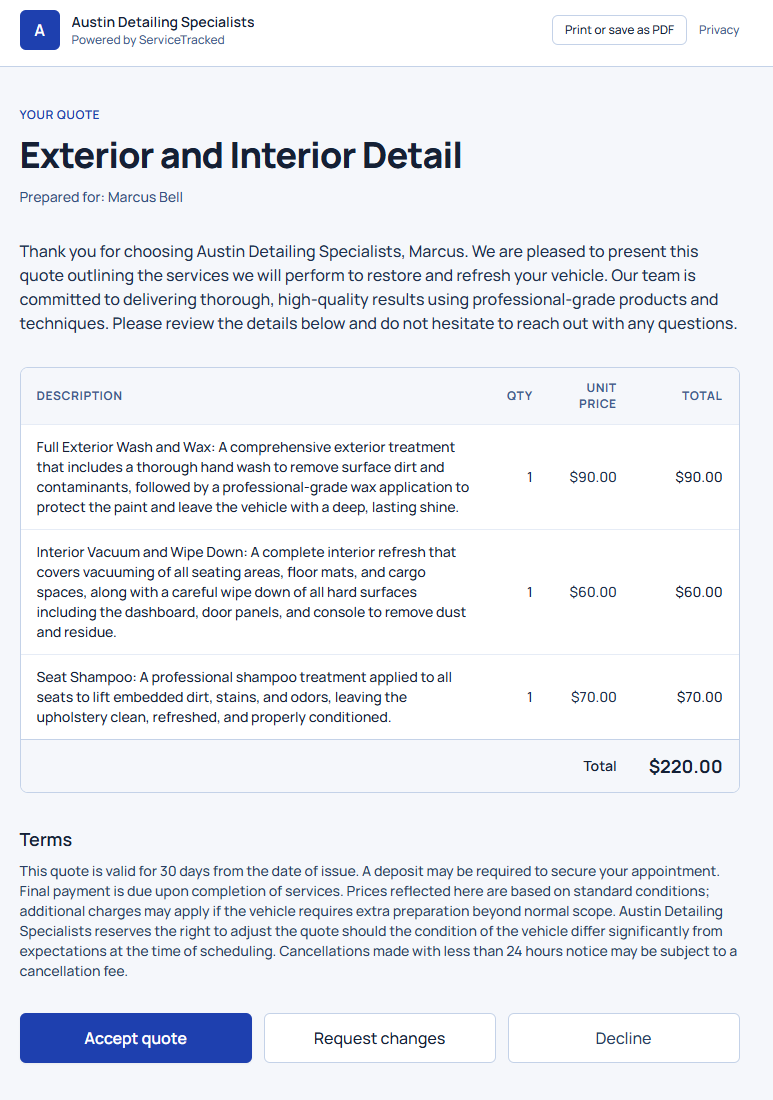
- Quote arrives in the customer's inbox formatted and branded: 30 seconds processing
Total per quote: under two minutes. Across a full day of quotes, the mechanics that used to eat hours shrink to minutes, and the quotes reach customers faster because they are sent while the customer is still paying attention.
Try it on your next job
Deliver a polished quote in under 60 seconds. Free Forever covers 10 quotes per month, no card.
Start free, no card requiredWhere the time actually goes in reporting
Report time tends to break down similarly:
- Sitting in the truck or van at the end of a job: 10 minutes per report
- Typing what you did, photo-by-photo: 10 to 15 minutes per report
- Attaching photos and formatting: 5 minutes per report
- Sending and saving a copy: 2 minutes per report
- Customer follow-up if they have questions: up to 10 minutes per affected report
Most service trades produce four to eight reports per day. At 20 to 30 minutes each, that is two to four hours daily.
The voice workflow:
- Voice memo at the end of the job: seconds
- Photos pulled from the phone automatically: 0 seconds (photos taken during the job)
- Report arrives in the customer's inbox formatted and branded: 30 seconds processing
Total per report: under two minutes per visit. What used to be hours of weekly reporting shrinks to a handful of minutes.
Customer back-and-forth
Customer messaging is the trickiest category to cut, because every conversation is different. But two patterns account for most of it:
Pattern 1: "Did you get my quote?"
Customers who do not hear back from a provider within an hour assume they were ignored. Then they message again. The provider then has to explain that they were busy on a job. Twenty minutes of conversational repair.
The fix: send the quote in under sixty seconds. The customer never has to ask whether you got their request. The problem goes away.
Pattern 2: "What was in the quote again?"
Customers lose quotes in their inbox. They ask for a copy. The provider has to find it, re-send it, and confirm the details.
The fix: every quote is in the customer portal at a predictable URL. The customer can pull it up themselves. The provider does not get the question.
Together, these two patterns account for much of the customer back-and-forth in a typical solo business. Removing them takes a real bite out of the weekly messaging load.
Try it on your next job
Deliver a polished quote in under 60 seconds. Free Forever covers 10 quotes per month, no card.
Start free, no card requiredBilling
Billing time is harder to cut because the underlying work (sending an invoice, getting paid, reconciling) is irreducible. But a service business that already produces clean quotes and reports has done most of the billing work without realizing it.
A quote that includes line items, a total, and a tax breakdown already captures most of what a bill needs. In ServiceTracked, the post-work report doubles as the receipt and invoice, so the record of work you finish is the bill your customer gets. There is no separate invoice step to produce, which is where most of the time in this category disappears.
Payment chasing is harder. A simple automated reminder system (or even a single follow-up at the 7-day mark) removes most of the manual chasing. The remaining time is just talking to the small number of customers who genuinely need a payment plan or a conversation.
Admin
Admin (taxes, insurance, licensing, business paperwork) is hard to cut because it is required by external parties. But it is the easiest category to delegate. A part-time bookkeeper saves you a few hours of your time per week, at a fraction of what your billable hour is worth. Most solo businesses should be hiring this out once their revenue can support it.
Try it on your next job
Deliver a polished quote in under 60 seconds. Free Forever covers 10 quotes per month, no card.
Start free, no card requiredThe compounded effect
Compress quoting and reporting with a voice workflow, remove the two most common customer-messaging patterns, automate payment reminders, and delegate the admin that does not need you. Do all of that and the weekly paperwork load shrinks dramatically. For a busy solo operator, reclaiming something on the order of two full workdays a week is realistic, and that can be the difference between burning out and growing the business to a team.
The recovered time goes to one of three places, depending on the stage of the business:
- More work. Reclaim two days a week for billable work and the business can grow without hiring.
- Better work. Keep the same volume but spend more time on each job, which supports a higher price.
- A real life. Keep both volume and price and just stop working weekends.
There is no wrong answer. The point is that the time exists. It is currently invisible because it is spread across fragments of the day.
What it actually feels like
A solo business owner who switches from manual quoting to a voice workflow describes the change as "I get my evenings back." The hours that used to be spent typing quotes after dinner go away. The customer experience improves at the same time, because quotes arrive faster and reports look more professional.
There is also a quality-of-life effect that is hard to measure. The owner who is not doing paperwork in the evening is the owner who answers their phone the next morning rested, and closes the next job with confidence.
Try it on your next job
Deliver a polished quote in under 60 seconds. Free Forever covers 10 quotes per month, no card.
Start free, no card requiredWhere to start
If paperwork is eating your week, the right place to start is the largest single bucket. For most service businesses, that is quotes. The voice workflow is the single highest-leverage change.
Try ServiceTracked free with Free Forever: 10 quotes and reports combined per month, no card required. If the workflow cuts your quoting time the way it should, you will know within a week. Upgrade to Solo at $49 per month when the math is obvious.
The goal is not to remove paperwork from your business. The goal is to make sure the paperwork takes seconds instead of hours, and that the time you spend in your business is the time that earns.
Try it on your next job
Deliver a polished quote in under 60 seconds. Free Forever covers 10 quotes per month, no card.