Hispanic-owned service businesses are one of the fastest-growing segments of the US economy. In trades like mobile detailing, lawn care, cleaning, painting, construction, roofing, and pressure washing, Spanish-speaking owners and operators account for a significant share of all new business formations in 2026. The owners who scale fastest are the ones who have figured out how to operate fluently across both Spanish and English customer bases without losing time, quality, or revenue to the language gap.
This guide covers the real challenges Spanish-speaking service business owners face in the US market, the patterns that work, and the specific tools that bridge language gaps to drive growth.
You (in Spanish)
After a deep clean
“Termine el departamento de Sarah, limpieza profunda. Cobre ciento ochenta. Ella prefiere ingles.”
Sunrise Cleaning Co.
Sarah Williams
3 bedroom, 2 bath deep clean
Quote #2048
Quote date
May 20, 2026
- Deep clean (kitchen, baths, bedrooms)$150
- Supplies and materials$30
Speak Spanish, send English. The customer reads it in their language.
The opportunity
The US service economy in 2026 includes tens of millions of potential customers whose first language is Spanish and tens of millions more who are bilingual but prefer Spanish for written communication. Combined, this is one of the largest underserved language markets in the country.
A Spanish-speaking service business owner has a structural advantage in serving this market: the trust, cultural fluency, and word-of-mouth network that English-only competitors cannot replicate. The owner who can also operate fluently with English-speaking customers has access to both markets.
The bottleneck is rarely demand. It is operational: producing professional documentation in two languages, managing a mixed-language team, and competing on speed with English-only competitors who do not have to translate anything.
The five biggest operational challenges
Hispanic service business owners we have talked with consistently surface the same five operational challenges. Each one has a fix.
Challenge 1: Producing English documents for English-speaking customers
A Spanish-speaking owner who types in English at one-third the speed of their native Spanish ends up either spending three times as long on quotes and reports, or producing documents that read awkwardly. Neither is acceptable for a business that competes on professionalism.
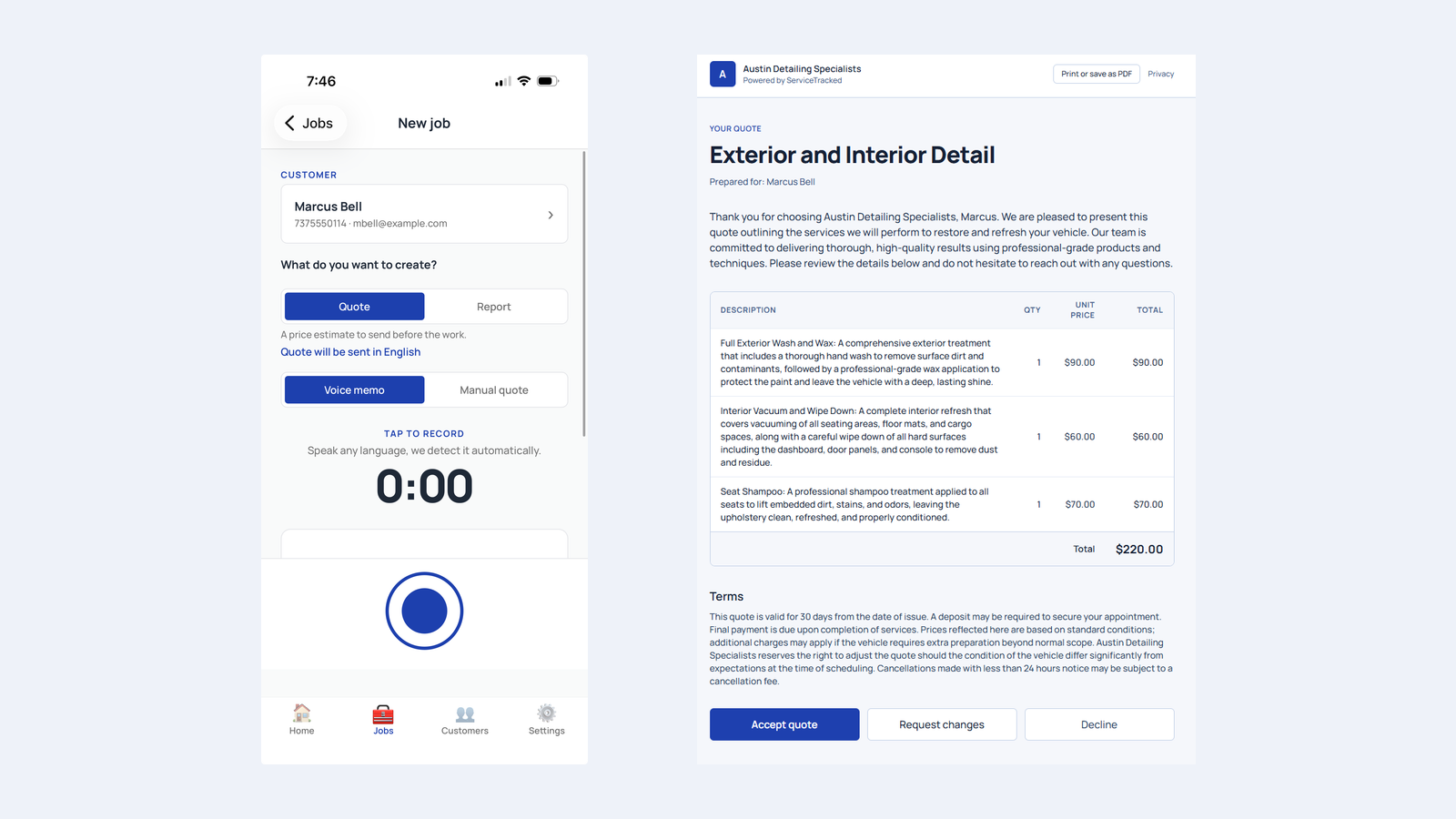
The fix: A workflow where the owner produces the document in Spanish and the customer receives it in English. The owner records a voice memo in Spanish. The system translates and formats the quote in English. The customer reads it in their preferred language. No typing penalty, no translation errors, no slow turnaround.
Challenge 2: Producing Spanish documents for Spanish-speaking customers
The reverse is also true for owners who learned the trade and the business in English: producing documents in polished Spanish for Spanish-preferring customers is harder than expected. Translation tools help but introduce errors.
The fix: Same workflow in reverse. The owner records in English; the customer receives in Spanish. Or the owner records in their best language and the customer's record determines the output language.
Challenge 3: Managing a multilingual team
A common team structure for a growing Hispanic-owned business is a Spanish-speaking owner plus a mix of Spanish-only and bilingual technicians. Coordinating across language preferences while producing English-language outputs for English-speaking customers is a daily friction.
The fix: Tools that let each technician work in their best language. A Spanish-only technician records a job report in Spanish; the customer receives it in English. The technician does their best work; the customer gets the polished output.
Challenge 4: Marketing to English-speaking customers
A Spanish-speaking owner whose written English is less fluent than their spoken English often hesitates to market actively to English-speaking customers. The result is a business that is over-indexed on Spanish-speaking customers and missing out on a large adjacent market.
The fix: Voice-first marketing. A voice memo recorded in Spanish can become a polished English landing page, a professional English quote, and a clean English customer communication. The owner's spoken Spanish becomes English-language marketing output without the writing penalty.
Challenge 5: Hiring across language lines
A Hispanic-owned business that wants to hire English-speaking technicians often runs into a chicken-and-egg problem: the English-speaking technician does not want to work for a business whose internal communication is in Spanish, and the Spanish-speaking owner does not want to operate in their second language internally.
The fix: Internal communication stays in Spanish (or whichever language is natural). Customer-facing communication is automatically translated to the customer's preferred language. The technician works in whichever language they prefer for the work itself.
Try it on your next job
Deliver a polished quote in under 60 seconds. Free Forever covers 10 quotes per month, no card.
Start free, no card requiredTrust and word-of-mouth
The reason Hispanic-owned service businesses grow fast in many markets is trust. A Spanish-speaking customer who hires a Hispanic-owned business gets cultural fluency, a shared language for the relationship, and a sense that the provider will treat them well. This translates directly into referrals.
Hispanic-owned service businesses often see strong referral rates. Word-of-mouth networks tend to be dense in Spanish-speaking communities, and a customer who had a great experience tells everyone.
The growth path for most successful Hispanic-owned service businesses follows this pattern:
- Start with friends, family, and neighbourhood referrals. Almost all customers Spanish-speaking.
- Word-of-mouth expands to the broader Spanish-speaking community, and the customer base grows.
- Bilingual customers start referring English-speaking neighbours. Business begins serving the English-speaking market.
- The challenge becomes producing equally professional output in both languages.
The owners who handle stage 4 well grow to multi-tech operations. The owners who struggle at stage 4 plateau at the size their language operating capacity allows.
What multilingual customer communication actually looks like
In a service business that has solved the language friction, the customer experience looks like this:
- A new customer messages in Spanish. The owner replies in Spanish (or the system replies in Spanish on the owner's behalf).
- The owner records a voice memo in Spanish describing the quote.
- The customer receives a Spanish-language quote with full line items, professional formatting, and the owner's branding.
- The customer accepts. The job is scheduled.
- After the work, the owner records a voice memo in Spanish describing the work and the photos.
- The customer receives a Spanish-language service report.
Meanwhile, an English-speaking customer goes through the identical workflow except every document arrives in English. The owner did not switch languages; the system did.
A bilingual customer might prefer Spanish for warmer informal communication but English for formal documents (because their assistant or accountant reads them). Most modern tools let the customer record set this preference at the field level: WhatsApp messages in Spanish, formal quotes and invoices in English.
Try it on your next job
Deliver a polished quote in under 60 seconds. Free Forever covers 10 quotes per month, no card.
Start free, no card requiredHiring tips for multilingual teams
A few patterns that work for Hispanic-owned businesses scaling a multilingual team:
Hire in Spanish-speaking communities through referrals
The fastest hiring channel for Spanish-speaking technicians is the existing team's referrals. Family, neighbours, friends. Trust is built into the hire.
Hire bilingual on the customer-facing roles
A bilingual dispatcher, office admin, or lead technician extends the business's reach into both language markets. Bilingual roles usually command a premium, and it tends to pay for itself.
Do not force English on field technicians
If a technician produces better work in Spanish, let them work in Spanish. Use voice-first tools that translate at the output layer. Forcing technicians to operate in their second language is the fastest way to lose your best people.
Pay attention to documentation hand-offs
Most multilingual teams have a stage where a Spanish-only technician hands off a job to a bilingual lead or owner who then communicates with the customer. The hand-off is where time is lost. Tools that automate the translation hand-off save hours per week.
The tools that work
For a Spanish-speaking service business owner in the US in 2026, the tool stack that consistently works:
You
Walking back to the van
“Black F-150, full interior shampoo and paint correction on the hood. Four eighty-five, can do it Saturday.”
Voice-first quoting and reporting
ServiceTracked is the most prominent voice-first tool in 2026 that supports Spanish-to-English and English-to-Spanish workflow natively, plus many other languages. The owner records in their best language; the customer receives in theirs. This single tool removes most of the operational friction described above.
WhatsApp for informal customer communication
WhatsApp is the default messaging app for most Spanish-speaking customers. A business that responds quickly to WhatsApp messages will out-compete one that only responds by email or text. Most modern customer communication tools support WhatsApp as a channel.
Spanish-language Google Business Profile
A Hispanic-owned business serving a Spanish-speaking community should run their Google Business Profile in Spanish, not English. The search visibility for Spanish-language queries ("detallado de auto cerca de mi") is much higher with Spanish-language listings.
Bilingual social presence
For Hispanic-owned businesses growing into both markets, a bilingual social presence (Instagram, TikTok, YouTube Shorts) with content in both Spanish and English captures the full market. The "Spanish version" of an Instagram post is not just a translation; it is a different post that resonates differently with the audience.
Try it on your next job
Deliver a polished quote in under 60 seconds. Free Forever covers 10 quotes per month, no card.
Start free, no card requiredWhat scaling looks like
A Hispanic-owned service business that scales cleanly through this pattern tends to share a shape over time:
- A customer base that is mostly Spanish-speaking, with a growing English-speaking share
- A small team of technicians, mixed bilingual and Spanish-only
- The owner spending most time on customer relationships, hiring, and quality control
- Operations running in Spanish internally, with English customer-facing output for English-speaking customers
This is the structural advantage of a Spanish-speaking service business owner in 2026: access to both the Spanish-speaking market (where trust and word-of-mouth are dense) and the English-speaking market (where pricing power is higher), without the operational tax of running every business process in two languages manually.
Try it
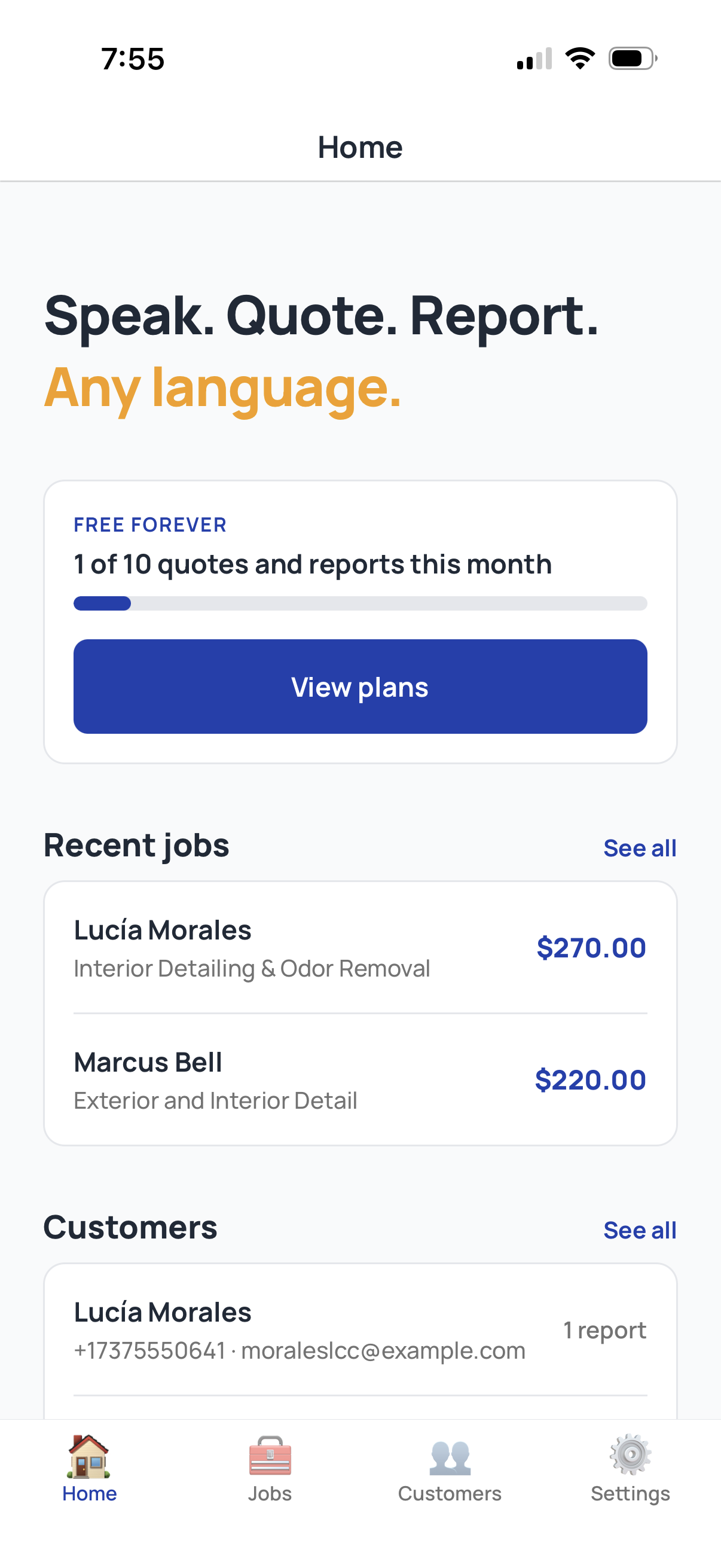
ServiceTracked is built for service businesses that operate across language gaps. The Free Forever tier covers 10 quotes and reports combined per month and supports many launch languages from day one. No card required. Try it on the next customer who messages you: record your response in whatever language you speak best, and the customer will receive it in theirs.
If your business has been stuck at a plateau because of operational language friction, the workflow change can be substantial. The first ten quotes will tell you whether it fits.
Try it on your next job
Deliver a polished quote in under 60 seconds. Free Forever covers 10 quotes per month, no card.