The single highest-leverage workflow change a service business can make in 2026 is to cut quote turnaround time from "later today" to "before the customer puts the phone down." When a customer requests three quotes for the same job and receives one of them within sixty seconds, that fast quote wins a large share of the bookings. The other two providers, no matter how good their pricing, often lose the job before they have finished typing.
This guide covers how to deliver a real, professional quote in under sixty seconds: the voice memo workflow, what to include in thirty seconds of speaking, the common mistakes, and concrete examples from five service industries.
Under 60 seconds
0:00
Record a voice memo
0:05
Transcribed automatically
0:30
Structured Quote or Report
0:60
Sent in the customer's language
Why speed beats price in 2026
Customers shop for service trades the same way they shop for restaurants on a Friday night. They send a short message to three or four providers. Whichever provider responds first, with a real answer, captures most of the consideration. The remaining providers are competing for a smaller pool of customers who care enough to wait.
The faster your quote arrives, the more likely you are to win the job. This is not because slow quotes are worse quotes. It is because customers move on. By the time the slower quote arrives, the customer has already booked or has moved their attention to something else.
The implication is direct. Whatever you do to speed up your quoting workflow has a larger impact on revenue than whatever you do to fine-tune your pricing.
You
Walking back to the van
“Black F-150, full interior shampoo and paint correction on the hood. Four eighty-five, can do it Saturday.”
The voice-to-quote workflow
The fastest way to deliver a real quote in 2026 is to talk through it. The mechanics:
- Open the customer's request. Read it once.
- Open your voice recording. Hit record.
- Talk through what you would do and what it would cost. Thirty seconds.
- Tap send. The quote is on its way.
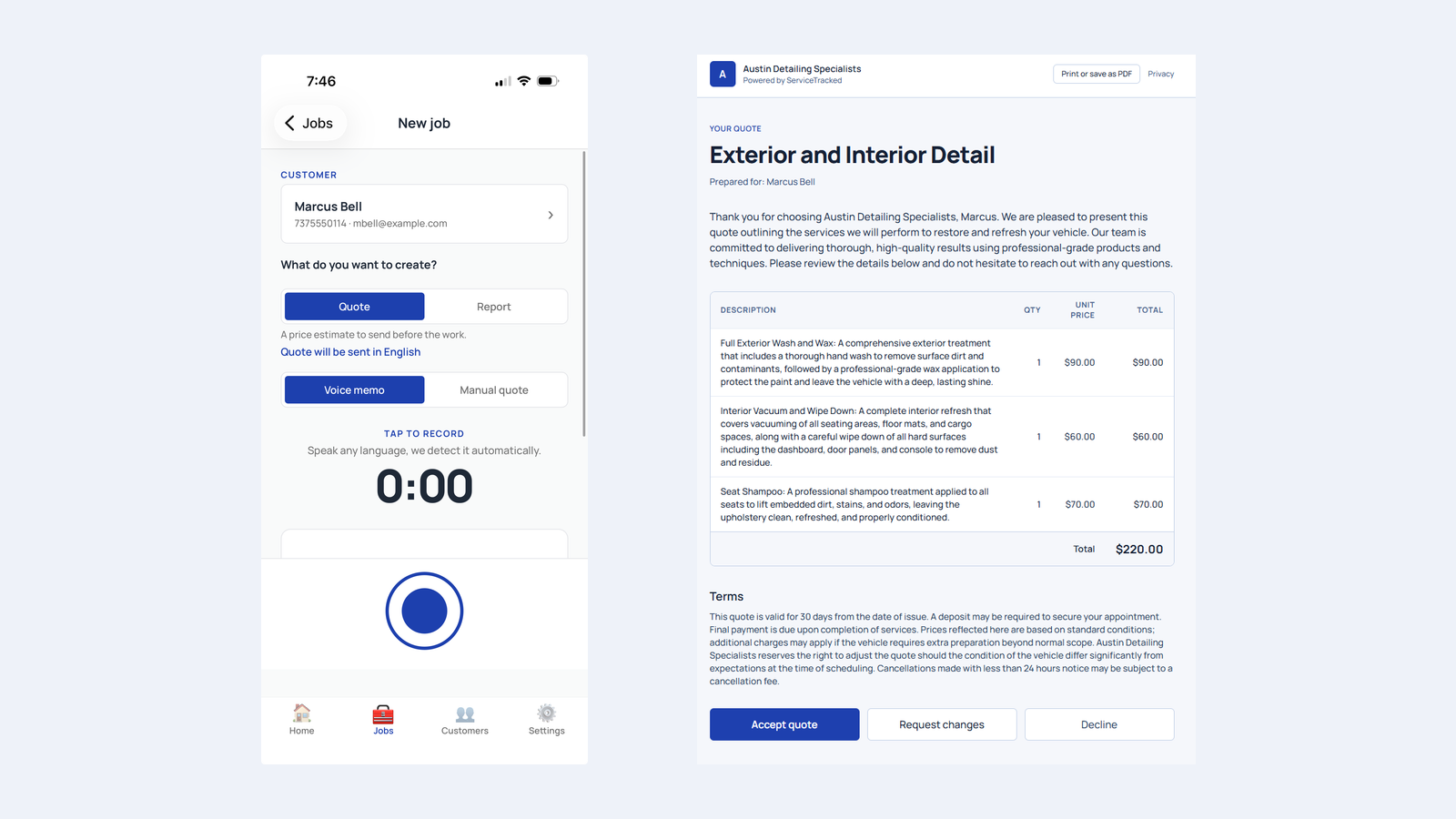
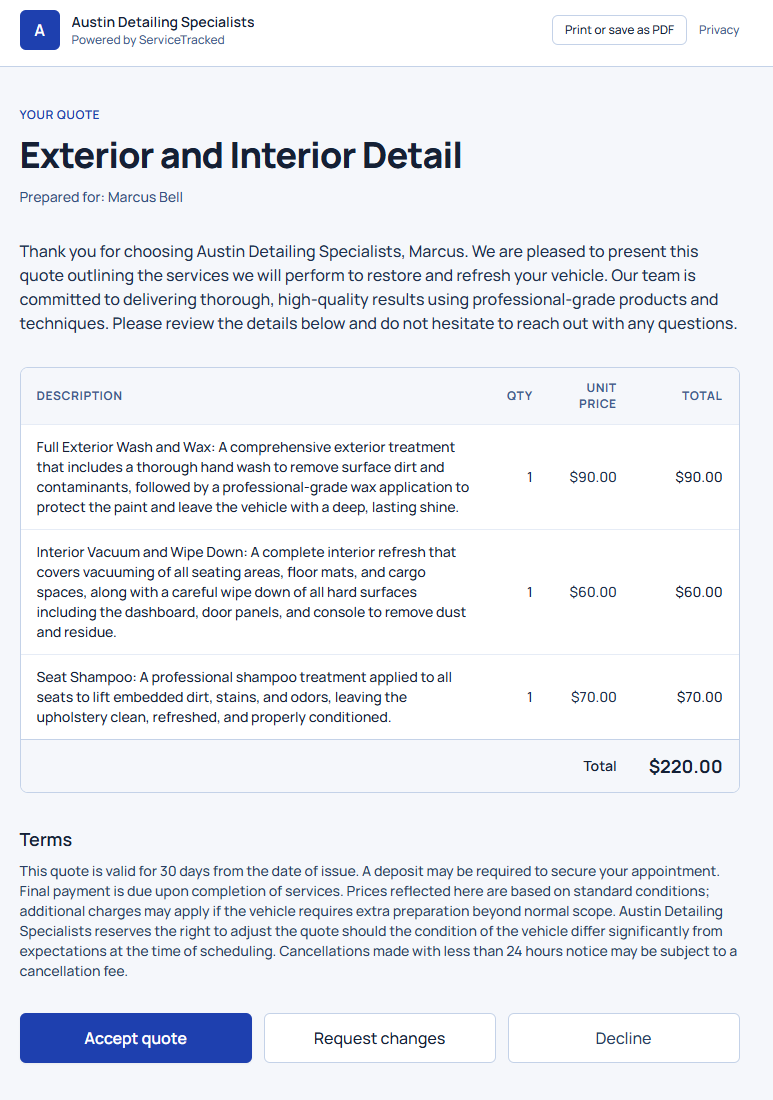
The total elapsed time is under two minutes from "customer message lands in your inbox" to "customer has a real quote in theirs." With ServiceTracked, the recording turns into a structured quote with line items, your branding, and a customer-portal accept button. The customer reads it, taps accept, and the job is booked.
A solo operator who quotes ten leads per week this way can respond to every one of them fast, while a manual quoter is still typing. Same number of leads, but a better booking rate because the responses arrive while the customer is still paying attention.
Try it on your next job
Deliver a polished quote in under 60 seconds. Free Forever covers 10 quotes per month, no card.
Start free, no card requiredWhat to include in thirty seconds of speaking
Most service trades can produce a complete, professional quote in thirty to forty-five seconds of speech. The pattern that works has five elements, in this order:
1. Customer and job identifier
Open with the customer's name and a brief description of the job. This is what anchors the rest of the memo:
Marcus Reyes, silver Tahoe, full interior and exterior detail.
The detailer who says "the silver Tahoe" without naming the customer ends up with a quote labeled vaguely. The detailer who names the customer up front gets a quote with the customer's name in the heading.
2. Condition or scope assessment
A short statement of what you found or what the job entails:
Heavy pet hair in the second row, swirl marks on the hood, water spots on the trunk. Standard exterior wash, hand polish, interior shampoo.
This is where most quoters get vague. Specificity is what makes a quote feel professional. "The customer wants a clean car" is not a quote. "Pet hair extraction in the second row, exterior wash, interior shampoo" is.
3. Line items
Walk through what is in the quote, item by item:
Interior detail $240. Pet hair extraction add-on $80. Exterior hand wash and spray sealant $60.
The customer reading the quote sees these as line items. Each one is justifiable. If the customer asks to cut $80, you remove the pet hair extraction, not the price.
4. Total and availability
Close with the total and when you can do the work:
Total $380. Available Saturday morning or Wednesday afternoon.
Offering two times is more effective than asking the customer when they are available. Most customers will accept one of the two times you suggested rather than negotiate a third.
5. Anything notable
If there is anything the customer should know that does not fit a line item, add it last:
Note: pet hair removal requires a steamer; will take an extra hour and we will need access to a power outlet.
The notable section earns trust. A customer who is told upfront that the job will take longer than they expected is a customer who is not surprised at the end.
Five-industry examples
The same five-element pattern works across every service trade.
Mobile detailing
Marcus Reyes, silver Tahoe. Heavy pet hair second row, swirl marks on hood, water spots trunk. Full interior detail $240, pet hair extraction $80, exterior hand wash and spray sealant $60. Total $380. Saturday morning or Wednesday afternoon. Note: pet hair takes the extra hour.
HVAC service call
Jennifer Pham, 1240 Oakhurst. Diagnostic showed weak capacitor, 28 microfarads, rated 35. Replace capacitor $180 parts and labour. Recommend system cleaning while we are there, additional $120. Total options: $180 capacitor only, $300 capacitor plus cleaning. Available tomorrow morning at 9 or 11. Note: if the unit is more than 10 years old, full system replacement quote available on request.
Pressure washing
Robert Hayes, 4520 Pine Ridge. Two-story home, vinyl siding, concrete driveway, brick walkway. Soft-wash siding and trim $360. Driveway and walkway $180. Total $540. Saturday or Sunday next weekend. Note: will need access to outdoor spigot and we will tarp the landscaping near the house.
Lawn care
Aiden Walker, 8 Maple Court. Standard biweekly service: mow, edge, blow off hard surfaces. Initial visit $85 (includes one-time hedge trim). Biweekly thereafter $55 per visit. Total first month $140. First visit Thursday or Friday this week. Note: gate code needed; reply with the code and we will save it.
House cleaning
Sara Chen, two-bedroom apartment, deep clean prior to move-in. Two cleaners, four hours. Total $320, includes all supplies. Available Monday or Thursday next week. Note: refrigerator interior and inside oven included; balcony excluded unless requested.
Same pattern in every trade. Customer name, scope, line items, total, availability, notable. Thirty to forty-five seconds of speech each.
Try it on your next job
Deliver a polished quote in under 60 seconds. Free Forever covers 10 quotes per month, no card.
Start free, no card requiredCommon mistakes
Three mistakes account for most slow quotes:
1. Trying to write the quote
The most common mistake is opening a note-taking app or an estimate form and typing the quote. Typing a four-line quote on a phone keyboard takes three to four minutes. Speaking the same quote takes thirty seconds. Stop typing.
2. Trying to be perfect before sending
Service business owners often hold a quote until they have looked up exact pricing or verified availability. The customer does not need exact. The customer needs a real, defensible range. "Total $380, possible range $360 to $420 depending on water access at the site" sends in sixty seconds. "Let me check my calendar and pricing and get back to you" sends in three hours and loses the job.
3. Following up too slowly
The second-most-common mistake is sending the first quote fast and then forgetting to follow up. A customer who has not responded in 24 hours should get a one-line follow-up: "Hi Marcus, just checking if you have questions on the quote. Happy to adjust scope if you have a target budget." A solo operator who follows up on every quote within 24 hours books more jobs than one who relies on the customer to circle back.
Multi-language quoting
The voice-to-quote workflow has a side effect that matters for any service business in a multilingual market: it removes the language friction that slows down quoting across language gaps.
A detailer who speaks Spanish best and types English slowly can record the voice memo in Spanish, and the quote is sent to the customer in English. The customer reads it instantly, taps accept, and the relationship starts on the right foot. Same workflow in reverse for a technician who speaks another language sending to an English-speaking homeowner.
The businesses that scale fastest in multilingual markets are the ones that quote at the same speed in every language they serve.
Apex Mobile Detailing
Marcus Lee
Black F-150, full interior + paint correction
Quote #2048
Quote date
May 20, 2026
- Interior shampoo and detail$285
- Hood paint correction$200
Try it on your next job
Deliver a polished quote in under 60 seconds. Free Forever covers 10 quotes per month, no card.
Start free, no card requiredWhat "real quote" actually means
Customers reading a quote in 2026 expect five things:
- A real total, not a range that does not commit
- Line items they can understand
- The provider's branding (logo, business name, contact info)
- A way to accept (tap a button, reply yes)
- A timestamp (so they know it was just sent and you are paying attention)
A "quote" that is a one-line text message with a number is not a quote. It is a guess. A line-item quote feels like a real business, even when the total is identical.
Producing a real, line-itemized quote in under sixty seconds is now a solved problem. The bottleneck is no longer the document; it is whether you have committed to the workflow.
Try it on your next quote
The next time a customer messages you with a job request, try the workflow:
- Read the message once.
- Hit record.
- Talk through the five elements: name, scope, line items, total, availability, notable.
- Tap send.
If you are using ServiceTracked, the recording becomes a structured quote with line items, your branding, and a customer-portal accept button, in under sixty seconds total. Free Forever covers 10 quotes and reports combined per month, with no card. Upgrade to Solo at $49 per month for unlimited quotes when you outgrow the free tier.
Try it on your next job
Deliver a polished quote in under 60 seconds. Free Forever covers 10 quotes per month, no card.